Three weeks ago this was a voice pipeline on a bench.
Now it maps, navigates, recovers, refuses — and publishes its own mistakes.
The milestone media: real mission data, the robot's own footage, and the diagrams behind the results. Everything below is measured, not staged.
The lidar was mirrored, and a second sign error was covering for it
Every consumer assumed the ring counted counter-clockwise; the firmware delivered clockwise. The turn verifier “worked” for weeks because its own sign error cancelled the mirror. Only two instruments cross-checked against each other caught it. After the fix, two independent rotation estimators agreed on hardware to 0.1° — and the robot's odometry became trustworthy enough to verify every single mission step.
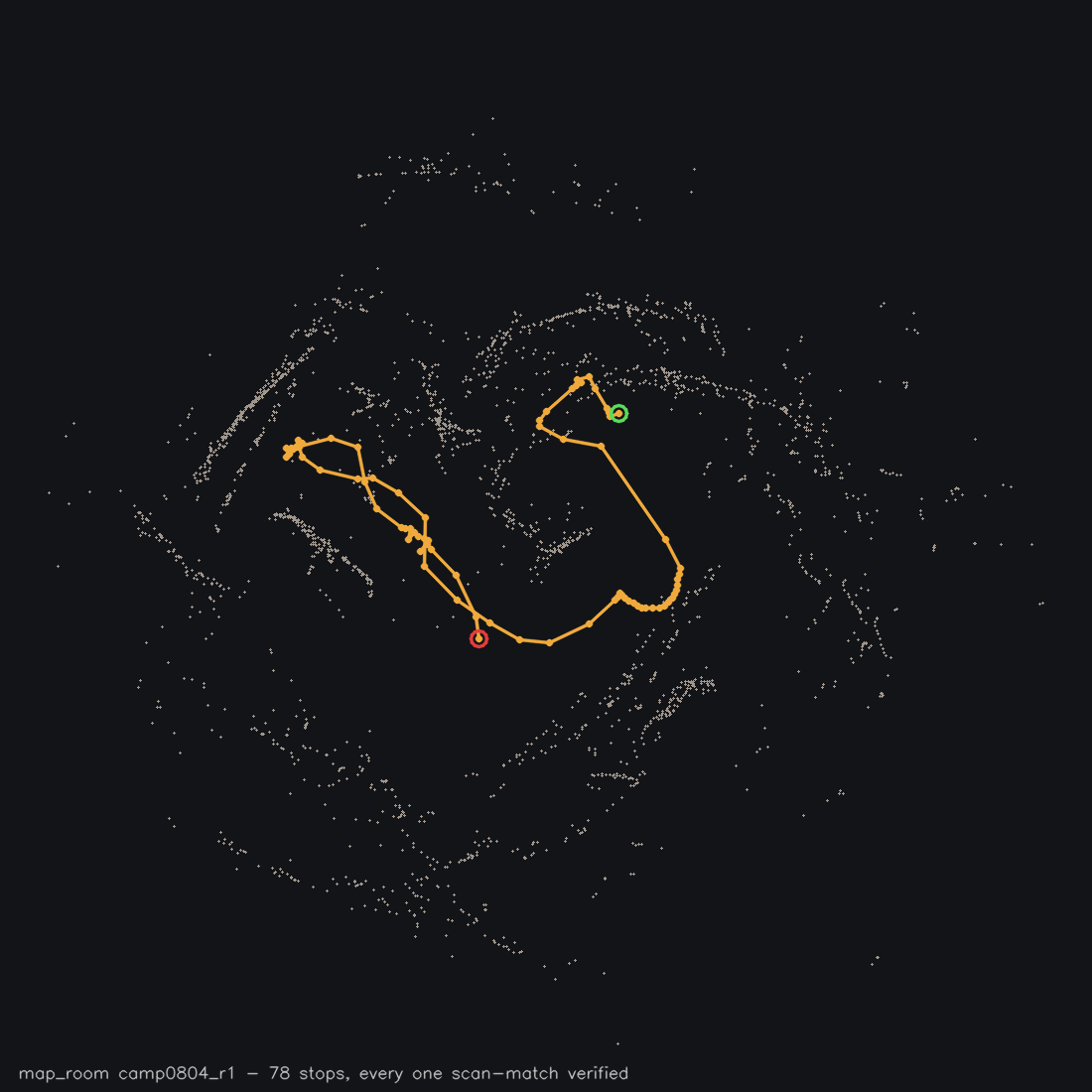
A person crossed the robot's path. The guard missed — so the miss became a fixture
The forward sentinel stopped an approaching person at 448 mm on its first live trial. A crossing person is different geometry — low closing rate, outside the forward watch — and the recorded miss was rebuilt into a 360° transient detector the same afternoon. The repeat test was caught twice (580 and 628 mm); the robot now waits for people instead of mapping them.

The hunt: stalk, declare, be wrong, rebuild, refuse
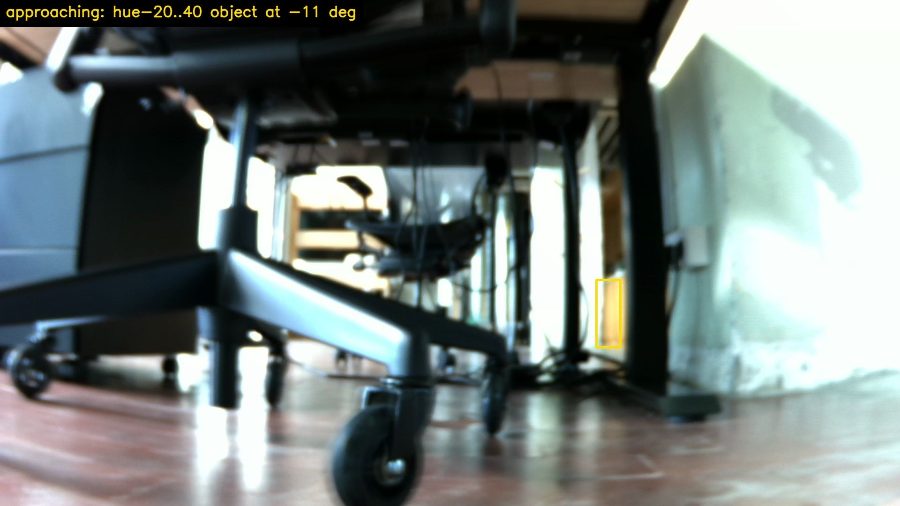
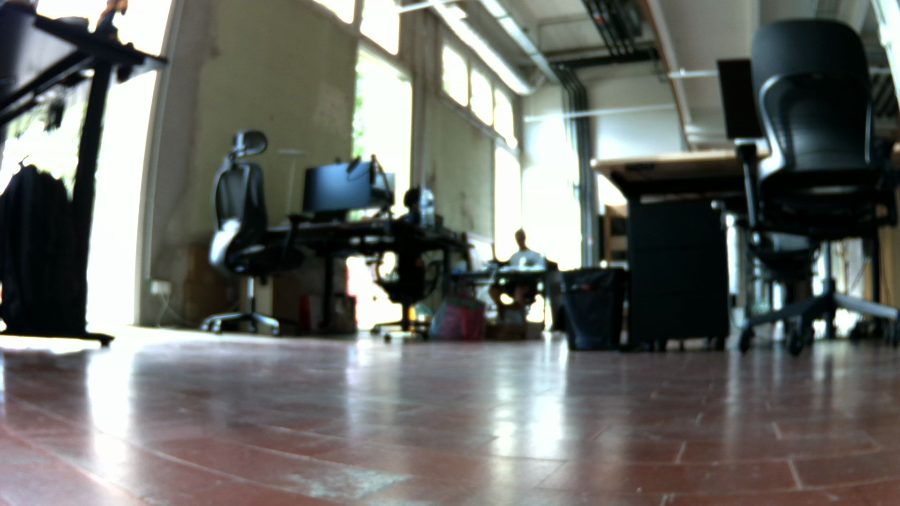
Asked to find a yellow package dropped somewhere in the clutter, the robot swept, sighted a dozen-pixel smudge at two metres, and stalked it through eight occlusion losses to under half a metre. Then it declared FOUND — on the wrong object. The close-range confirm had been a leading question, and the model agreed with it. The arbiter is now non-leading (“name what you see”), a sighting is a hypothesis to investigate closely, and the re-run hunt ended “not found” rather than repeat the lie.
Know which layer owns which job
The simulation series proved a ~4B vision-language model is a superb local controller and a hopeless global router: goal-reach went 12% → 40% (hand it reachable subgoals from a layer that owns the map) → 85% (train it to that interface) → 92% with no prior map at all, built while driving. The hardware platform is that prescription made physical — deterministic layers below, learned controller (still undeployed) above.
flowchart TB
  D["deterministic layers\nown the map, routing, sensing, pose"] --> A["chassis\nself-calibrated actuator model"]
  V["learned controller (sim: 92%)\nNOT deployed to hardware"] -.->|"future"| D
  style V stroke-dasharray: 5 5
Sim media lives on the public card: closed-loop maze runs, including the no-prior-map run where the map draws itself under the robot — ubr-physical-ai/UBR-Nav-E4B (hero GIF and the 92%-row animation, plus every number above with its failure history).
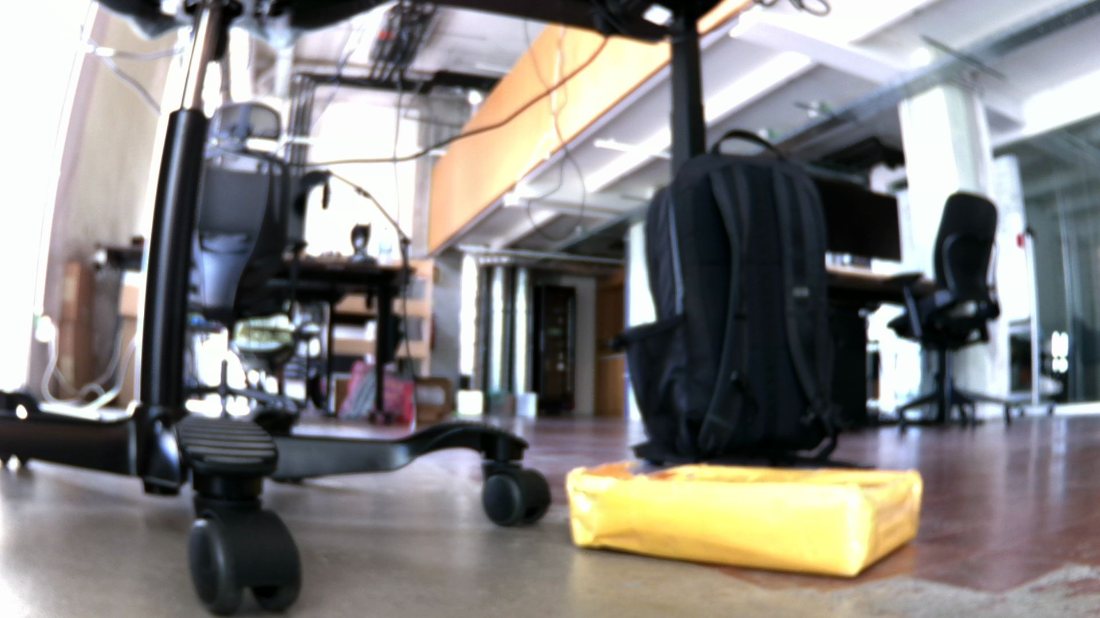
Found: the yellow mailer, frame-verified
The package hunt that produced the retraction ended the same day, the right way: with every lesson active at once — coverage memory, the calibration-free anomaly eye, the non-leading naming arbiter with a required color word, no-go memory for rejected spots, target commitment — the robot swept, rejected four more candidates by name (including, at one point, its own chassis), crossed the room, and stopped here. The model's close-range verdict: “Yellow rectangular bag.” A human checked the frame. It is the package.
The tilt climb, halted and self-rescued
Mid-mission the robot climbed an obstacle it couldn't see. The firmware's rollover reflex halted the tracks at 51°; the brain then walked it back down in reverse pulses until the horizon was level, verified it was stable before trusting its own pose again, marked the climb on the map, and replanned around it. Nobody touched it.
Also earned these weeks
A 53° tilt climb ended in self-rescue and an operator-designed stabilization doctrine. A sealed-route refusal became an escape through a gap the raw scan could still see. The stair-leg collision (invisible to every sensor) bought a progress watchdog that has since caught an unseen obstacle mid-mission. The wall-follower's stability went from folklore to a derivation to an executable test. Battery envelope: 4.78 W idle, 10.88 W under full LLM load — about 3 h of heavy autonomy per pack. And the dataset finally has ears: two silent bugs (a renumbered ALSA card and arecord rejecting fractional seconds) meant every “audio” campaign to date had recorded zero clips — fixed and field-verified today, 24/24.